At a Glance
Compared to this destination's peak season Winter splits sharply. The year-end holidays (Dec 23–Jan 3) are among the priciest dates of the year: hotels can double, Hatsumode draws ~3M to Meiji Jingu over Jan 1–3, and much of the city closes. From about January 5 through February, Tokyo drops into its low season with the year’s best hotel rates and smallest crowds. December illuminations + Winter Comiket (Dec 29–31) are the other festive-peak draws; Mt Fuji clear-view from Tokyo peaks Dec–Jan (~60–68%).
Tokyo in Winter — Travel Guide
By Harry Nara · Last updated
Tokyo in Winter offers some of the best conditions of the year, ideal for illuminations, mt fuji views & winter value. Expect temperatures of 1–12°C, around 4–6 days of rain, and medium crowds across the city. Daily budgets typically land around ¥6,000–80,000+ for mid-range travellers. Book three to four weeks ahead for the best mid-range rates and the widest hotel choice.
Contents14 sections
Winter is Tokyo at its clearest and calmest: the summer crowds long gone, the avenues strung with illuminations, and the year's sharpest views of a snow-capped Mount Fuji floating on the horizon on a cold, dry morning. Winter runs December through February, and like the other seasons it is really three different trips stacked together, from the festive, expensive crescendo of the year-end holidays to the quiet, cheap, crystal-clear deep winter that follows. This guide covers the full arc and, more usefully, helps you decide which winter month fits the trip you actually want. Once you have chosen, our day-by-day Tokyo in December, Tokyo in January, and Tokyo in February guides take it from there.
#Weather in Tokyo in Winter
Tokyo in Winter averages 1–12°C (34–54°F) with around 4–6 days of rain, and crowds are medium.
| Month | Temps | Character |
|---|---|---|
| December | Highs ~12°C / 54°F easing to 10°C / 50°F, nights near 3°C / 37°F | The mildest of the three |
| January | About 1°C / 34°F at night to 10°C / 50°F by day | The coldest, and the clearest |
| February | Barely warmer than January | Carries the first hint of spring in the plum blossom |
Snow is rare in central Tokyo, falling only once or twice a season and usually melting within hours.
Mt Fuji clear-view odds run roughly 60–68% in December and January, the year's highest.
Figures are Japan Meteorological Agency 1991–2020 normals.
What that actually means for your trip:
- Cold, but dry and sunny. That combination makes a Tokyo winter far more pleasant than the raw grey damp of many northern-hemisphere cities.
- The clear air is the whole point. It strips away the haze that hides Mount Fuji for most of the year, which is why this is the season to plan a mountain sighting.
- You will spend the day peeling off and pulling back on. Trains, shops and restaurants are thoroughly heated, so dress in layers rather than one heavy coat.
- Snow is a bonus, not a risk. On the rare day it settles, the city becomes extraordinarily quiet and photogenic.
Which winter month should you pick? January for the clearest Fuji odds and the emptiest city after New Year. February if you want near-identical conditions plus the plum gardens at their peak. December is the mildest but also the busiest, with the year-end rush and illuminations pushing rates up.
#What to Do in Tokyo in Winter

Which winter month should you pick?
This is where a winter trip is decided, because each month is a genuinely different experience.
December is the festive peak, and the most expensive and crowded. It is the month of illuminations, of Christmas Eve celebrated as Japan's biggest romantic date night, and of bonenkai, the year-end parties that fill every izakaya. It closes with a rush: the Winter Comiket fan convention fills Tokyo Big Sight from December 29 to 31, the temples ring their Joya no Kane bells on New Year's Eve, and the Hatsumode shrine crowds roll straight into January 1. The year-end window, roughly December 23 to January 3, is one of the priciest of the whole Tokyo year. Choose December for illuminations, festive energy, and New Year tradition. Full detail in our Tokyo in December guide.
January is the clear, quiet, high-value month. It delivers the year's best Mount Fuji views and its cleanest winter light, the New Year Grand Sumo Tournament (the Hatsu Basho, January 10 to 24 in 2027) at Ryogoku, Coming of Age Day (January 11 in 2027) with its gorgeous furisode kimono, and the fukubukuro lucky-bag frenzy of the first three days. Crucially, once Hatsumode clears around January 5, the tourists thin, the queues vanish, and hotel rates fall to among the lowest of the year. Choose January for clear skies, Mount Fuji, sumo, and value. Full detail in our Tokyo in January guide.
February is the coldest month, but it turns toward spring. Setsubun on February 3 chases out the year's demons with thrown soybeans, the plum blossoms (ume) open from early in the month at shrines like Yushima Tenmangu, the Sapporo Snow Festival draws day-trippers north to a city of ice sculptures (February 4 to 11 in 2026), and the earliest cherry blossoms of the year appear at Kawazu on the Izu Peninsula. Mount Fuji stays sharp, and crowds are the lowest of the year. Choose February for plum blossoms, Setsubun, and off-peak calm. Full detail in our Tokyo in February guide.
The clearest skies of the year: Mount Fuji viewing
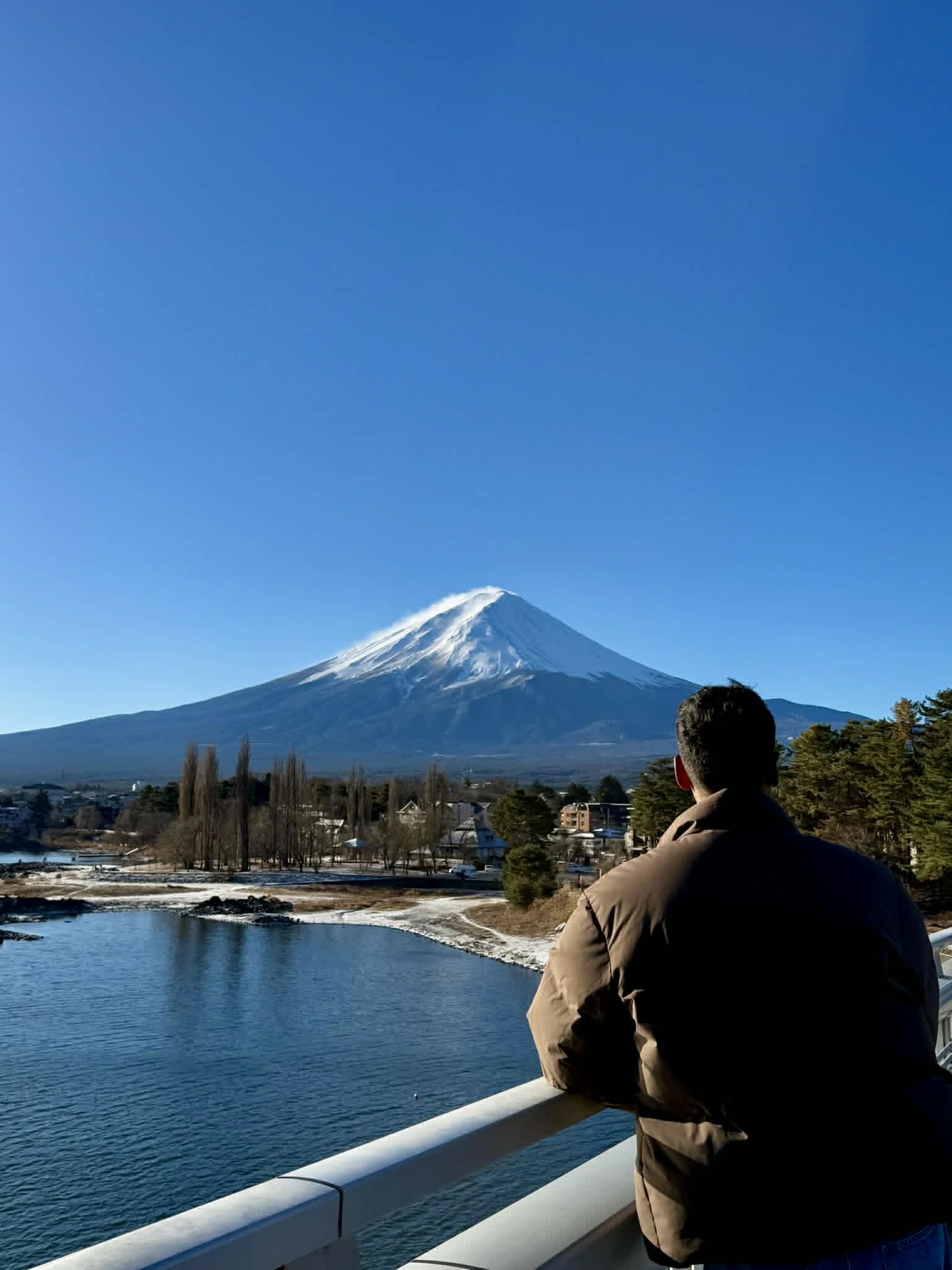
Winter is the single best season to see Mount Fuji from Tokyo. The cold, dry air scours away the summer haze, and the odds of a clear view from the city peak in December and January at roughly 60 to 68 percent on any given day, the highest of the year. The window is early, from 6 to 8am, before the daytime haze builds. In the city, the Tokyo Skytree's Tembo Galleria, the free observatory atop the Tokyo Metropolitan Government Building in Shinjuku, and the Bunkyo Civic Center all frame the mountain on a clear morning. For Fuji up close, day-trip to Kawaguchiko, about 90 minutes from Shinjuku, for the classic lake-and-mountain view, or to Hakone for the peak framed by an onsen town.
Winter illuminations
From November into mid-February, Tokyo drapes itself in light, and the illuminations are the definitive winter evening out. The headliners include the champagne-gold Marunouchi avenues between Tokyo Station and the Imperial Palace, which run to about February 15; the Caretta Shiodome "Canyon of Light" sound-and-light show; the Roppongi Hills Keyakizaka lights with Tokyo Tower glowing behind them; Tokyo Midtown's illumination and its outdoor ice rink; the Baccarat crystal chandelier at Yebisu Garden Place; and Shibuya's blue-lit Ao no Dokutsu, the "Blue Cave". Omotesando's zelkova avenue glows warm-white through December. All are free, all run every evening, and together they are the heart of a Tokyo winter.
Year-end into New Year, and the deep-winter calm
The winter calendar builds to a crescendo and then empties. December fills with bonenkai year-end parties; Christmas Eve on the 24th is Japan's biggest romantic night out; and on New Year's Eve the temples ring the Joya no Kane, 108 strikes of the great bells to dispel the year's earthly desires, most beautifully at Zojo-ji beneath a floodlit Tokyo Tower and at Senso-ji in Asakusa. Then comes Hatsumode, the first shrine visit of the year, when some three million people crowd Meiji Jingu across January 1 to 3. And then, almost overnight, it goes quiet: from about January 5 the tourists thin, the queues disappear, hotel rates fall by half or more, and the city settles into a calm, clear, inexpensive deep winter that runs through February. It is the great value secret of the Tokyo year.
Snow, day trips, and plum blossoms
Because central Tokyo so rarely sees snow, a guaranteed white landscape means heading out: the shrines of Nikko under snow, the Hakone highlands, or a bullet-train ski day at Gala Yuzawa, all easy from the city. February adds the Sapporo Snow Festival, a short flight north to a city of giant ice-and-snow sculptures, and the first cherry blossoms of the year at Kawazu on the Izu Peninsula. Back in Tokyo, the plum blossoms open from early February, most fragrantly at Yushima Tenmangu, a quiet, near-empty preview of the sakura still weeks away.
#Getting Around
Tokyo's transport is the world's most efficient.
From Narita Airport, the Narita Express reaches central Tokyo in about 90 minutes (¥3,070) and the Keisei Skyliner reaches Ueno in 53 minutes (¥2,570); Haneda is far closer, with the Keikyu Line reaching Shinagawa in 35 minutes (around ¥600). Pick up a Suica or Pasmo IC card on arrival: it covers every train, subway, and bus, plus convenience stores and vending machines. Carriages are heated and comfortable all winter, and the rare central-Tokyo snowfall usually causes only minor delays, with the underground Metro lines effectively unaffected.
The one thing to plan around is New Year. Many lines run a holiday timetable from about December 29 to January 3, extra trains are laid on for the Hatsumode shrine crowds, and the major stations are packed on January 1 to 3, so build in extra time. If you want the winter Mount Fuji day trip, the direct buses and trains to Kawaguchiko fill on clear-forecast weekends, so book ahead.
#Budget & Costs
| Travel style | Per day | Per night |
|---|---|---|
| Budget | ¥6,000–9,000 | Hostel dorm ¥2,500–4,000 |
| Mid-range | ¥13,000–22,000 | Business hotel ¥8,000–14,000 |
| Luxury | ¥40,000+ | Premium hotel, private onsen |
Winter splits in two.
The year-end holidays, roughly December 23 to January 3, are among the most expensive dates of the whole Tokyo year with hotels sometimes doubling; the rest of the season, and especially mid-January through February, is Tokyo's low season with the best rates and smallest crowds of the year. The budget tier runs on hearty ramen and udon plus a ¥600 one-day Metro pass; mid-range assumes sit-down dinners at ¥3,000 to ¥5,000 and more for a room over New Year; and luxury covers kaiseki from ¥10,000.
What things cost:
| What | Price |
|---|---|
| Hakone onsen day trip | ¥4,000–6,000 |
| One-day Metro pass | ¥600 |
| Winter illuminations | Free |
Where the money actually goes:
- Two weeks are peak and the rest is the annual low. December 23 to January 3 can double hotel rates; mid-January through February is the cheapest stretch of the Tokyo year.
- The illuminations cost nothing. They run through the expensive window and well past it.
- An onsen day trip is the season's signature spend. Hakone at ¥4,000–6,000 return is the one thing worth budgeting for beyond the daily rate.
- There is no tipping anywhere. Menu and shelf prices include tax, so the figure you see is the figure you pay.
Winter is the season to visit Tokyo if the priority is the city rather than the calendar. Skip the twelve days around New Year and you get the clearest skies of the year, the best chance of seeing Mt Fuji from the city, the lowest hotel rates and the smallest crowds, all at once. Nothing closes and nothing is diminished. It is simply cold, and Tokyo in winter is a dry, bright, entirely manageable cold that most visitors underestimate in the wrong direction.
#Food & Dining

Winter is hot-pot season above all. A bubbling communal nabe is the definitive cold-weather meal, whether shabu-shabu swished in broth, richly sweet sukiyaki, oden simmered in dashi, or chanko-nabe, the hearty stew of the sumo stables, best eaten in Ryogoku near the arena. Ramen is at its most satisfying in the cold, konbini oden steams by every convenience-store register, and warm sake (atsukan) is the drink of the season. It is peak strawberry season too, with jewel-like Amaou and Tochiotome berries stacked in the fruit parlours. And New Year brings foods of its own: toshikoshi soba slurped on New Year's Eve for long life, the lacquered tiers of osechi, and ozoni, a mochi soup, on New Year's Day. Assemble any of it, or a full New Year spread, at a department-store depachika.
#Nightlife
Winter nightlife is about warmth and light. The illuminations are the season's headline evening, free and everywhere, but the drinking is at its cosiest too. December and January are the season of bonenkai and shinnenkai, the year-end and new-year parties that pack the tiny izakaya of Shinjuku's Omoide Yokocho and the yakitori joints under the Yurakucho train tracks, all charcoal smoke and steamed-up windows. Warm-sake bars, the ten-seat stools of Golden Gai, the city's dense jazz scene, and late nights at Womb in Shibuya round out the season, and New Year's Eve brings countdown crowds to Shibuya Crossing, Tokyo Tower, and the Skytree.
#Shopping
The season's shopping event is fukubukuro, the New Year lucky bags stuffed with mystery goods worth far more than the purchase price, with queues forming before dawn on the first days of January (Isetan Shinjuku opens January 2; Daimaru, Takashimaya, and Matsuya Ginza on the 3rd). Winter sales follow. The Christmas markets, led by the German-style market on Gyoko-dori beside Tokyo Station through late November to December 25, sell mulled wine and ornaments, and the department stores run the December gift season with their basement food halls at their most tempting. Tax-free shopping for tourists is available at most major stores; carry your passport.
#Culture & Etiquette
New Year (O-Shogatsu) is Japan's most important holiday, and much of the city closes from December 31 to January 3, so plan meals around the convenience stores and chains that stay open. Hatsumode has its own gentle etiquette: toss a five-yen coin (go-en, a homophone for good fortune) into the offering box, bow twice, clap twice, bow once, and perhaps draw an omikuji paper fortune. Setsubun on February 3 brings mame-maki, the throwing of roasted soybeans to drive out demons, and the eating of a whole ehomaki sushi roll while facing the year's lucky direction. Coming of Age Day fills the shrines with twenty-year-olds in spectacular furisode kimono. And the year-round rules hold: slip off your shoes at a raised entrance, keep your voice down and phone silent on trains, carry cash for temples and small restaurants, and never tip, as it is simply not done.
#Essential Local Phrases
| English | Japanese | Sounds like |
|---|---|---|
| Happy New Year! | あけましておめでとう | Ah-ke-mash-te o-me-de-toh |
| It's cold! | 寒いですね! | Sa-mui des-ne! |
| Where can I see Mount Fuji? | 富士山はどこから見えますか? | Fuji-san wa doko kara miemasu ka? |
| Is there a hot spring nearby? | 近くに温泉はありますか? | Chikaku ni onsen wa arimasu ka? |
| How much is this? | いくらですか? | Ee-koo-ra des-ka? |
| Thank you | ありがとうございます | Ah-ree-gah-toh go-zai-mas |
| The bill, please | お会計をお願いします | O-kaikei wo onegai shimasu |
| Merry Christmas | メリークリスマス | Meri- Kurisumasu |
#Packing List
- A genuinely warm winter coat, since Tokyo winters are cold even if snow is rare
- Thermal underlayers (Japan's own Heattech is sold everywhere) for all-day sightseeing
- Gloves, a scarf, and a hat for December and January evenings
- Comfortable, warm walking shoes for long days on foot
- Hand warmers (kairo), cheap at any convenience store and invaluable on cold days
- Lip balm and a small moisturiser, since the winter air is very dry
- Cash in yen, especially over New Year when some card machines go offline
- A portable phone charger, as the cold drains batteries faster
- Any prescription medicine with a translated note, since Japan restricts some drugs
#Safety & Health
Winter is one of Tokyo's safest and most comfortable seasons, cold but dry and clear, with none of summer's heat danger. The main concern is the cold-and-flu season: crowded trains and dry, heated indoor air raise transmission, so wearing a mask indoors is common and sensible, and hand sanitiser is worth carrying. The dry air itself can irritate skin and airways, so pack lip balm and a small moisturiser. Snow is rare and, when it falls, briefly slows above-ground trains while leaving the underground Metro largely unaffected. Earthquakes are a background possibility, so note your hotel's exits on arrival. Beyond that, Japan remains one of the safest countries in the world, with very low crime, and winter streets are quiet and secure even late at night. Tap water is safe everywhere, and emergency numbers are 110 for police and 119 for ambulance or fire. Some Western cold and flu medicines containing pseudoephedrine are restricted, so bring your own supply with a translated note, and travel insurance is strongly recommended.
#Backup Plans (Cold or Rainy Days)
A cold snap or a rare winter shower is easy to wait out indoors.
teamLab Planets in Toyosu is a fully indoor water-and-light art world, best booked ahead, and the Tokyo National Museum in Ueno holds the world's finest collection of Japanese art. A cold afternoon is the perfect excuse for an onsen: a public bath such as Thermae-yu in Shinjuku, or a full day out at Hakone.
And Akihabara, a multi-storey warren of electronics, anime, and gaming, is a self-contained indoor world that can swallow a whole day, as can grazing a department-store depachika out of the cold.
#What's Changed for 2026/2027 Travellers
- Winter is the year's best Mount Fuji window. December and January give the clearest views from Tokyo, around 60 to 68 percent odds on any day. Aim for a 6 to 8am west-facing deck.
- The illuminations now run into mid-February, with the Marunouchi lights on until about February 15, overlapping the first plum blossoms.
- New Year 2027 dates are set: the New Year Grand Sumo Tournament runs January 10 to 24, Coming of Age Day falls on January 11, and Setsubun is on February 3.
- The deep-winter value window is real. From about January 5 through February, hotel rates fall to the year's lowest and the crowds thin, even as the weather stays clear.
#About This Guide
This seasonal overview is written to help you choose your winter window, then hand you straight to the month you need: our full Tokyo in December, Tokyo in January, and Tokyo in February guides carry the day-by-day detail. Mount Fuji visibility and climate figures draw on Japan Meteorological Agency data and observation-deck records; festival and New Year dates on the official shrine and event calendars; the sumo schedule on the Nihon Sumo Kyokai. Reviewed and updated in July 2026 by Harry Nara.
You might also like
Destinations picked for travellers with similar taste or climate.
Frequently Asked Questions
Which winter month is best to visit Tokyo?
December is the festive peak, with Christmas illuminations, Christmas Eve as Japan's biggest date night, Winter Comiket (Dec 29–31), and the Joya no Kane New Year's Eve bells, but it is also the most expensive and crowded over the year-end holidays. January is the clear, quiet, high-value month: the year's best Mount Fuji views, the New Year Grand Sumo Tournament (Jan 10–24 in 2027), Coming of Age Day (Jan 11 in 2027), fukubukuro lucky bags, and low prices once Hatsumode clears around January 5. February is the coldest but turns toward spring, with Setsubun (Feb 3), the first plum blossoms, and the lowest crowds of the year. Pick December for festivities, January for clear skies and value, February for plum blossoms and calm.
When can I see Mount Fuji clearest from Tokyo?
December and January give the year's clearest views, with roughly a 60 to 68 percent chance of a clear sighting from the city on any given day; February stays sharp too. The best window is early, 6 to 8am, before the daytime haze builds. In the city, try the Tokyo Skytree's Tembo Galleria, the free observatory atop the Tokyo Metropolitan Government Building in Shinjuku, or the Bunkyo Civic Center. For Fuji up close, day-trip to Kawaguchiko (about 90 minutes from Shinjuku) or to Hakone.
Does it snow in Tokyo in winter, and how cold is it?
Snow is rare in central Tokyo, falling only once or twice a season and usually melting within hours; for a guaranteed white landscape, day-trip to Nikko, Hakone, or the Gala Yuzawa ski slopes. It is genuinely cold (January runs about 1 to 10°C) but famously dry and sunny, and every train, shop, and restaurant is thoroughly heated, so a warm coat plus layers you can peel off indoors is the key.
Is winter a cheap time to visit Tokyo?
Mostly yes, with one big exception. The year-end holidays (December 23 to January 3) are among the most expensive dates of the year, with hotels sometimes doubling and much of the city closing over January 1 to 3. From about January 5 through February, Tokyo drops into its low season, with the year's best hotel rates and smallest crowds, all while the winter weather stays clear.