At a Glance
Compared to this destination's peak season Three concrete spikes in an otherwise good-value season: the Deepavali weekend (Sun Nov 8, 2026 plus the Mon Nov 9 holiday) fills Little India; the marathon weekend (Dec 4–6) closes roads around Marina Bay and the Esplanade; and the Christmas-to-New-Year fortnight (roughly Dec 20–Jan 2) pushes Marina Bay hotels to their annual peak, often with minimum-stay rules. Mid-November and mid-to-late January are the genuine bargains. Chinese New Year 2027 falls Sat Feb 6, outside this window, so January delivers the Chinatown light-up run-up rather than the festival itself. Public transport fares rose on 27 Dec 2025 (adult card fares now S$1.28–2.57).
Singapore in Wet Season — Travel Guide
By Harry Nara · Last updated
Singapore in Wet Season offers some of the best conditions of the year, ideal for festival lovers, foodies & value seekers. Expect temperatures of 23–31°C, around 17–19 days of rain, and moderate crowds across the city. Daily budgets typically land around $60–1,500+ for mid-range travellers. Book three to four weeks ahead for the best mid-range rates and the widest hotel choice.
Contents14 sections
#Weather in Singapore in Wet Season
Singapore in Wet Season averages 23–31°C (73–88°F) with around 17–19 days of rain, and crowds are moderate.
| Measure | Nov to Jan |
|---|---|
| Daytime high | 30–31°C / 86–88°F |
| Overnight low | 23–25°C / 73–77°F |
| Humidity | 85–95%, thick even when nothing is falling |
| November | 252mm across 19 wet days |
| December | 287mm across 19 wet days, the wettest month of the year |
| January | 235mm across 17 wet days |
| Monsoon surges | Two or three consecutive days of cool grey rain, temperatures dropping to 22–24°C / 72–75°F |
This is the Northeast Monsoon, and the pattern matters far more than the totals.
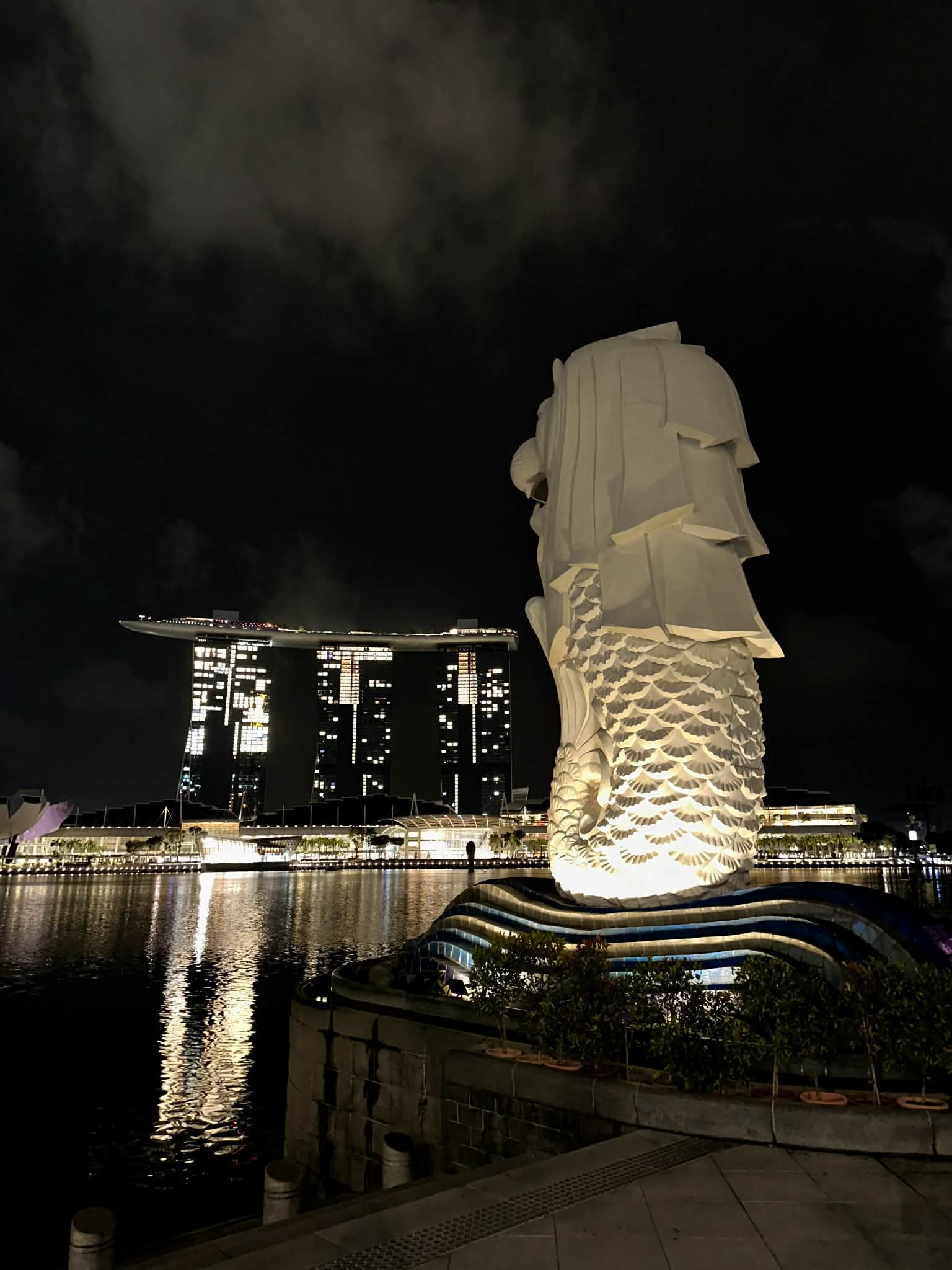
What that actually means for your trip:
- Most wet-season rain is a short violent afternoon storm. The sky goes charcoal around 3pm, the downpour lands, and 60 to 90 minutes later the pavements are already steaming dry.
- Mornings are frequently clear, and they are your best outdoor window. Build wet-season days back to front.
- Surges are the real disruption. They are the only time Singapore genuinely feels cold, and the only time a whole day can be a write-off. The Meteorological Service Singapore flags them in its fortnightly outlook.
- Take lightning warnings seriously. Singapore records one of the highest rates of lightning activity anywhere on earth, and it peaks now. Golf courses clear, school sport stops, and the OCBC Skyway and Singapore Flyer suspend operations. If you hear thunder, get under a roof.
Should you come in the wet season? December is spectacular and expensive; January after the New Year is the value pick, with the rain easing and the crowds gone. Either way, plan mornings outdoors and treat the afternoon as flexible, and the season is far more workable than the rainfall totals suggest.

#What to Do in Singapore in Wet Season

Deepavali and the Little India Light-Up (Sunday 8 November 2026)
Deepavali 2026 falls on Sunday 8 November, with Monday 9 November gazetted as the public holiday. It is the reason November is the most photogenic month of the wet season: Serangoon Road is strung with illuminated arches, peacocks and oil-lamp motifs for weeks either side of the date, and the whole of Little India stays lit deep into the night.
The Deepavali Festival Village bazaar takes over Campbell Lane and the surrounding streets in the run-up, selling garlands, saris, brassware, sweets and enough fairy lights to rewire a small country.
The Indian Heritage Centre on Campbell Lane runs an open house around the festival with free entry, henna artists and rangoli demonstrations. Both are free to wander. Confirm this year's exact light-up window on VisitSingapore's Deepavali page, which publishes in the autumn.
Christmas on A Great Street (Orchard Road, November 2026 to 1 January 2027)
Orchard Road's light-up is one of the largest in Asia, and it costs nothing.
The display now covers the full 3.1km from Tanglin to Dhoby Ghaut, with a 14-metre Christmas tree, two temporary Christmas Villages carrying rides and stalls, projection mapping across the facade of Hilton Singapore Orchard, and nightly artificial snowfall shows that reliably delight everyone under ten and a surprising number of adults. The 2025 edition switched on 8 November and ran to 1 January; the 2026 edition follows the same November-to-New-Year window, with dates confirmed on the official Orchard Road Christmas site in the autumn.
The Great Christmas Eve Street Party on 24 December closes part of the road for live performances, food trucks and a midnight countdown. It is genuinely joyful and genuinely packed.
Christmas Wonderland at Gardens by the Bay (late November to 1 January)
Singapore's biggest festive event takes over the Supertree Grove with a European-style Christmas market, luminarie light arches, carnival rides and nightly snowfall.
Timed-entry sessions run from 6.30pm to 11pm, with last entry around 10.15pm.
Tickets in the 2025 edition started at S$9 adult and S$7 child bought in advance, rising to S$11–15 for same-day purchase, with under-3s free. Any guide still quoting a S$5 ticket is years out of date. Sessions on the weekends between mid-December and New Year sell out; book the 6.30pm slot if you want to photograph the market in blue hour before the crowd thickens.
The Singapore Marathon, under a new name (4 to 6 December 2026)
The city's flagship race has both a new name and a new shape. What most people still call the Standard Chartered Singapore Marathon now runs as the BYD Singapore International Marathon presented by adidas, with Standard Chartered's name attached to the 10km event rather than the whole meet.
The 2026 edition occupies the weekend of 4 to 6 December, with the full marathon on Sunday 6 December and a 4.30am flag-off to beat both the heat and the storms. For the first time, the marathon and the half-marathon are split across separate days.
ZoukOut on Siloso Beach (December)
Asia's best-known beachfront dance festival returns to Siloso Beach on Sentosa in December, running dusk to dawn across multiple stages. Dates and the line-up are announced through the autumn on Zouk's own channels. Treat any line-up you see on a third-party aggregator as unconfirmed until it appears there: the festival's billing changes late and the resale sites are not reliable.
Marina Bay Singapore Countdown (31 December)
Singapore's New Year's Eve is public, free and ticketless, and it is genuinely world class. Fireworks launch from barges across the bay, the buildings around the waterfront carry synchronised projections, and the signature installation is a field of roughly 20,000 illuminated wishing spheres carrying half a million handwritten wishes collected from the public through December.
The prime free vantage points are the Esplanade waterfront, the Promontory, Marina Bay Sands Event Plaza and the Helix Bridge. Programme details land on the official Marina Bay Countdown site in December.
Thaipusam (Friday 22 January 2027)
Thaipusam is the most extraordinary thing you can witness in Singapore, and in 2027 it falls squarely inside the wet season on Friday 22 January. (In 2026 it landed on 1 February, outside this window, which is why some older January guides skip it entirely.)
Devotees carry kavadi, ornate steel structures anchored to the body with skewers and hooks, on a roughly 4km procession from Sri Srinivasa Perumal Temple on Serangoon Road to Sri Thendayuthapani Temple on Tank Road.
The procession begins around 11.30pm the night before and continues right through the following day, accompanied by chanting, drumming and family members carrying milk pots. It is free, it is open to everyone, and details are published by the Hindu Endowments Board.
The Chinese New Year run-up (January 2027)
Chinese New Year 2027 falls on Saturday 6 February (the Year of the Goat, also rendered as the Sheep), which puts the festival itself just outside the wet season. What January gets is the build-up, and the build-up is arguably the better experience.
Chinatown's Street Light-Up typically switches on three to four weeks ahead, which puts it in mid-January 2027, and the festive street bazaar fills Pagoda, Trengganu and Sago Streets with waxed meats, pineapple tarts, bak kwa queues and lanterns.
You get the lanterns, the lion-dance rehearsals and the bak kwa without the two-day public-holiday shutdown, when a large number of independent shops and hawker stalls close entirely.
The rain-proof circuit
On a monsoon-surge day, Singapore is the best rainy city on earth, and it rewards planning rather than mourning.
The National Gallery Singapore (from S$25) holds the world's largest public collection of modern Southeast Asian art and comfortably absorbs three hours.
The ArtScience Museum at Marina Bay Sands runs blockbuster immersive shows.
The Asian Civilisations Museum, the Peranakan Museum and the National Museum of Singapore are all a short walk from City Hall MRT and connected by covered routes.
The Cloud Forest and Flower Dome at Gardens by the Bay are fully enclosed and, in a downpour, genuinely spectacular: the 35-metre indoor waterfall reads very differently with a real storm hammering the glass.
#Getting Around
Changi Airport (SIN) connects to the city on the East-West MRT line, with covered walkways the entire way, so a wet-season arrival need not involve getting wet at all. Reckon on roughly 30 minutes to City Hall.
Taxis downtown run S$25–45 plus the Changi surcharge; Grab and Gojek price similarly and surge hard during storms.
Fares changed on 27 December 2025. The Public Transport Council's 2025 fare review raised adult card fares by up to 10 cents a journey (cash fares by 20 cents), so an adult tapping in with a card now pays from S$1.28 for a short hop, rising through distance bands to roughly S$2.57 for a long cross-island ride. Older guides quoting a flat "S$1 to S$3" are close, but out of date at the bottom of the range.
Pay with an EZ-Link card (available at any MRT station) or simply tap a contactless Visa or Mastercard through SimplyGo, which charges identical fares with no card to buy. Both work across MRT, LRT and buses.
On New Year's Eve, roads around Marina Bay close progressively through the evening and MRT services run extended hours into the small hours of 1 January. Do not plan on driving anywhere near the bay that night.
#Budget & Costs
| Travel style | Per day | What it covers |
|---|---|---|
| Budget | S$60–95 | Hostel dorm, hawker meals, MRT everywhere |
| Mid-range | S$120–180 | 3 or 4-star hotel, hawker and casual mix |
| Comfortable | S$250–400 | 4 or 5-star hotel, restaurants, paid sights |
| Luxury | S$600–1,500+ | Marina Bay Sands, Fullerton, Raffles, Capella |
Wet season is the best-value stretch of Singapore's year, with one large exception: the fortnight around Christmas and New Year, when rates rise sharply and Marina Bay hotels impose minimum stays.
Mid-November and mid-to-late January are the genuine bargains. Hostel dorms are S$25–45/night and three or good four-star hotels S$140–240/night.
Reference costs:
| What | Price |
|---|---|
| Universal Studios Singapore | S$83 |
| Mid-range restaurant | S$40–80 |
| Marina Bay Sands SkyPark | S$32 |
| Gardens by the Bay | S$32 |
| Taxi, Changi to downtown | S$25–45 |
| Casual restaurant | S$15–30 |
| Beer in a bar | S$12–18 |
| Christmas Wonderland, advance | S$9 |
| Hawker meal | S$5–10 |
| MRT single ride | S$1.28–2.57 |
Where the money actually goes:
- Two windows are the actual bargains. Mid-November and mid-to-late January sit well below the rest of the year, while the Christmas and New Year fortnight sits well above it.
- New Year's Eve is priced as an event, not a night out. A rooftop package with a fireworks view is S$200–500+ per person and considerably more at the top end.
- Minimum stays are the hidden constraint. Marina Bay hotels impose them across the festive fortnight, so compare total stay cost rather than the nightly rate.
- Christmas Wonderland is the cheap festive option. From S$9 in advance, it costs less than a beer.
Wet season pricing rewards anyone willing to look at a calendar properly. Ten and a half months of the year, Singapore in the rain is the cheapest version of an expensive city, and the rain itself arrives in short heavy bursts rather than ruining days. The fortnight around New Year inverts all of it, with higher rates, minimum stays and event pricing on top. Book mid-November or mid-to-late January and the wet season is a genuine bargain; book the last week of December and it is the most expensive Singapore there is.
#Food & Dining

Wet-season eating in Singapore is an upgrade rather than a compromise. The food locals actually crave in a storm is the food that travels worst in 33°C sun: laksa, bak kut teh, char kway teow, claypot rice, hot bak chor mee. Hawker centres are covered but open-sided, so eating a bowl of laksa while a thunderstorm hammers the roof is one of the definitive Singapore experiences, not an inconvenience.
- Maxwell Food Centre (Chinatown) for Tian Tian Hainanese chicken rice at S$5–7, and a queue that is worth joining exactly once.
- 328 Katong Laksa in Katong for the coconut-heavy laksa, its noodles cut short so the whole bowl is eaten with a spoon.
- Founder Bak Kut Teh (Balestier) for the peppery Teochew pork-rib soup that seems to have been invented for grey afternoons.
- Hill Street Tai Hwa Pork Noodle for Michelin-starred bak chor mee. The wait is long and the bowl justifies it.
- Lau Pa Sat in the CBD, whose satay street spills onto Boon Tat Street from about 7pm each evening, with a roof over the tables.
- Long Beach Seafood for white-pepper crab at roughly S$80–100 per kilogram, the underrated sibling of chilli crab.
- Candlenut in Dempsey Hill, the world's first Michelin-starred Peranakan restaurant, at S$100–150 a head.
Festive dining books out hard.
Christmas Eve, Christmas Day and New Year's Eve set menus at hotel restaurants go on sale in October, and the good ones are gone by late November.
#Nightlife
Wet season pushes Singapore's drinking indoors, which is no hardship in a city with one of Asia's deepest cocktail benches.
Atlas in Bencoolen, with its art-deco gin tower, remains the most photographed bar in the country.
Manhattan at the Conrad Centennial is a fixture of the World's 50 Best Bars list.
28 HongKong Street is the original speakeasy and still one of the best.
Native on Telok Ayer builds everything from Southeast Asian ingredients.
Jigger & Pony is a perennial regional number one.
For a view with cover, CÉ LA VI on the Marina Bay Sands rooftop has sheltered seating, which means you can watch a December electrical storm break across the bay from a bar stool.
Note that 1-Altitude at One Raffles Place is closed for redevelopment and is not an option, whatever the older listicles still say.
Zouk at Clarke Quay remains the anchor club, and it is the same operation behind ZoukOut in December.
#Shopping
Singapore was purpose-built for shopping in the rain.
Orchard Road's malls (ION Orchard, Takashimaya, Paragon, Tangs, Wisma Atria, Mandarin Gallery) are stitched together by underground links, and the CBD is walkable end to end under cover.
Note that the Great Singapore Sale in its old centralised form ended after 2022. There is no longer a single island-wide sale season. Individual malls and brands run their own promotional calendars instead, and the heaviest discounting now clusters around Black Friday in late November and the post-Christmas sales from 26 December, both of which sit inside the wet season.
Elsewhere: Bugis Street Market for cheap fashion, Haji Lane in Kampong Glam for independents, Tiong Bahru for design and bakeries, and Mustafa Centre in Little India, open around the clock and stocking everything from saffron to laptops.
Tourists can reclaim the 9% GST on purchases above S$100 at Changi.
#Culture & Etiquette
- November to January is festival season across three faiths at once. Deepavali, Christmas, the Western New Year and the Chinese New Year run-up overlap, and Singapore celebrates all of them in public and without irony.
- Religious sites: cover shoulders and knees at Sultan Mosque (Kampong Glam), Sri Veeramakaliamman (Little India), Sri Mariamman (Chinatown) and the Buddha Tooth Relic Temple. Remove shoes at temple entrances. Mosques restrict non-Muslim visitors around Friday midday prayers.
- At Thaipusam and Deepavali, ask before photographing people. Devotees in a trance state, and families making offerings, are not street-photography subjects.
- Tipping is not the custom. Restaurants add 10% service and 9% GST automatically.
- The fines are real: littering (from S$300), eating or drinking on the MRT (up to S$500), jaywalking, and carrying durian on public transport (prohibited outright).
- Drug laws are among the harshest anywhere. Trafficking carries a mandatory death penalty and possession carries long custodial sentences. Never carry anything for anyone.
#Essential Local Phrases
Singapore has four official languages plus Singlish (a localised English-Malay-Hokkien-Tamil blend). You'll get by in plain English everywhere, but a handful of local words will help you read menus, order at hawker stalls, and understand what people are saying.
| What you want to say | What you'll hear in Singapore |
|---|---|
| Yes / OK | Can lah (Singlish) |
| No / Cannot do | Cannot (Singlish) |
| Delicious | Shiok (Singlish) |
| To eat / Let's eat | Makan (Malay, universally used) |
| It's raining | Hujan (Malay) |
| Let's shelter for a bit | Go shelter first lah (Singlish) |
| Iced coffee at a hawker stall | Kopi peng (Hokkien) |
| Spicy | Pedas (Malay) |
| Bill, please (at a restaurant) | Mai dan (Mandarin) |
| Thank you | Terima kasih (Malay) / Xie xie (Mandarin) |
| Sentence emphasis | Lah (added at the end) |
#Packing List
- A compact umbrella. Not optional; afternoon thunderstorms are close to daily.
- A lightweight rain jacket for monsoon-surge days, when an umbrella alone loses to the wind.
- Cotton or linen clothing. Synthetic fabrics turn clammy at 90% humidity.
- A long-sleeved layer for interiors. Singaporean air conditioning is set to a temperature best described as punitive.
- Closed walking shoes that tolerate puddles, plus sandals for everything else.
- Sunscreen. The clear morning windows carry equatorial UV even in December.
- A Type G adapter (the same three-pin plug as the UK).
- A refillable water bottle. Tap water is safe and excellent.
#Backup Plans (Rainy Days)
Singapore is the best rainy-day city on earth, and the honest answer to "what if it rains" is: almost nothing changes. The CBD is knitted together by underground walkways and connected malls, and the MRT keeps you dry between districts.
The museum circuit alone can absorb three wet afternoons: the National Gallery Singapore (from S$25), the ArtScience Museum at Marina Bay Sands, the Asian Civilisations Museum, the National Museum of Singapore and the Peranakan Museum.
The Cloud Forest and Flower Dome at Gardens by the Bay are fully enclosed.
Universal Studios Singapore on Sentosa keeps operating in light rain, though rides pause in lightning.
The S.E.A. Aquarium next door is one of the largest in the world. And hawker centres, covered but open-sided, are arguably at their best mid-storm.
The one genuine wet-season casualty is the outdoor-attraction shutdown during lightning: the Singapore Flyer, the OCBC Skyway at the Supertrees, cable cars and the Sentosa luge all suspend service. Keep an indoor option in your back pocket for any day built around those.
#Safety & Health
Singapore is one of the safest cities in the world. Violent crime is rare and pickpocketing is uncommon even in the busiest tourist areas. Wet season shifts the risk profile rather than raising it.
Lightning is the genuine seasonal hazard: Singapore records among the highest strike densities on the planet, and the wet season is peak. Take shelter when you hear thunder, and do not shrug off the closure of an outdoor attraction as over-caution.
Dengue is a year-round concern, and wet-season standing water raises mosquito breeding. Use repellent in the evenings, especially in green, low-rise neighbourhoods, and check the NEA dengue cluster map if you are staying outside the centre.
Heat and humidity still bite despite the rain. Dehydration and heat exhaustion are entirely possible on a grey 31°C day at 90% humidity.
Vaping penalties rose sharply on 1 May 2026. Possession or use of an e-cigarette now attracts a fine of up to S$10,000, up from S$2,000, and vapes are routinely detected at Changi customs. Etomidate-laced pods, known locally as Kpods, are now handled under drug law: possession can carry up to 20 years' imprisonment and caning. These rules apply to tourists exactly as they apply to residents. Leave the device at home.
Drug laws are among the harshest in the world; trafficking carries a mandatory death penalty. Never carry a bag or package for someone else.
Tap water is safe and excellent. Healthcare is world class and expensive, so travel insurance is strongly recommended.
Emergency numbers: 999 (police), 995 (ambulance and fire).
#What's Changed for 2026/27 Travellers
- The marathon has been renamed. The Standard Chartered Singapore Marathon is now the BYD Singapore International Marathon presented by adidas (4 to 6 December 2026), with Standard Chartered now sponsoring the 10km event. The marathon and half-marathon have also been split across separate days for the first time.
- Public transport fares rose on 27 December 2025. Adult card fares now run from S$1.28 to roughly S$2.57; cash fares rose 20 cents.
- Vape penalties multiplied on 1 May 2026: up to S$10,000 for possession, with Kpods handled under drug law.
- Chinese New Year 2027 falls on Saturday 6 February, outside the wet season. January delivers the Chinatown light-up and the street bazaar, not the festival itself.
- Thaipusam 2027 falls on Friday 22 January, which does sit inside the wet season. In 2026 it fell on 1 February and missed the window entirely.
- Christmas Wonderland now starts at S$9 in advance, not the S$5 that older guides quote.
- 1-Altitude is closed for redevelopment. It appears on a lot of "best rooftop bar" lists that have not been updated.
- The Great Singapore Sale no longer exists as a centralised island-wide event; it ended after 2022. Black Friday and the post-Christmas sales are where the discounting now lives.
#About This Guide
Research for this guide combined traveller reports from r/singapore and Tripadvisor's Singapore forum with primary and near-primary sources: the Public Transport Council's 2025 fare review for the 27 December 2025 fare adjustment; VisitSingapore and PublicHolidays.sg for Deepavali falling on Sunday 8 November 2026 with the Monday holiday; the official Orchard Road Christmas site for the Christmas on A Great Street format, the 3.1km Tanglin-to-Dhoby-Ghaut run and the Christmas Eve street party; Gardens by the Bay for the Christmas Wonderland session times and current ticket pricing; the BYD Singapore International Marathon site for the 4 to 6 December 2026 dates, the renaming and the new two-day format; the Marina Bay Singapore Countdown site for the wishing-spheres installation and the free vantage points; the Hindu Endowments Board for the Thaipusam procession route and the Friday 22 January 2027 date; the Health Sciences Authority for the vaping penalties that rose on 1 May 2026; and the Meteorological Service Singapore for the Northeast Monsoon climate normals, the monsoon-surge pattern and the fortnightly outlook. Climate figures use MSS/NEA 1991-2020 normals.
You might also like
Destinations picked for travellers with similar taste or climate.
Frequently Asked Questions
How wet is Singapore's wet season, really?
December is the wettest month at around 287mm across 19 wet days, November averages 252mm across 19 days, and January eases to 235mm across 17 days. But almost all of it falls in short, violent afternoon or early-evening thunderstorms lasting roughly 60 to 90 minutes. Mornings are frequently clear. Plan outdoor activity for 8am to noon and indoor activity from 2pm and the season barely inconveniences you. The genuine exception is a monsoon surge.
What is a monsoon surge?
A surge is a strong pulse of northeasterly wind funnelling down the South China Sea, parking over the peninsula and producing two or three consecutive days of cool, grey, persistent rain with daytime temperatures dropping to 22 to 24°C. It is the only time Singapore feels genuinely cold and the only time an entire day can be a write-off outdoors. The Meteorological Service Singapore flags surges in its fortnightly outlook, so check weather.gov.sg before locking in outdoor plans.
What's on in Singapore between November and January 2026/27?
Deepavali falls on Sunday 8 November 2026 (with Monday 9 November as the public holiday), lighting up Serangoon Road for weeks. Christmas on A Great Street runs the full 3.1km of Orchard Road from November to 1 January, and Christmas Wonderland takes over the Supertree Grove with tickets from S$9. The renamed BYD Singapore International Marathon (formerly Standard Chartered) runs 4 to 6 December. ZoukOut returns to Siloso Beach in December, and the free Marina Bay Countdown closes the year on 31 December. Thaipusam then falls on Friday 22 January 2027.
Does Chinese New Year fall in the wet season?
Not in 2027. Chinese New Year 2027 lands on Saturday 6 February, just outside the November-to-January window, so January visitors get the build-up rather than the festival. That is arguably the better deal: Chinatown's Street Light-Up typically switches on three to four weeks ahead (so around mid-January 2027), and the festive street bazaar fills Pagoda, Trengganu and Sago Streets. You get the lanterns, the lion-dance rehearsals and the bak kwa queues without the two-day public-holiday shutdown, when many independent shops and hawker stalls close.
What’s the weather like in Singapore in Wet Season?
Singapore in Wet Season typically sees temperatures of 23–31°C with around 17–19 days of rain across the period. Pack light, breathable layers and strong sun protection — days get genuinely hot.
How much does it cost to visit Singapore in Wet Season?
Budget-conscious travellers can expect daily costs of $60–1,500+, covering accommodation, food, and local transport. Flexible dates can save up to 20% compared with peak-week rates.