At a Glance
Compared to this destination's peak season The F1 Singapore Grand Prix has MOVED to October: the 2026 race runs Oct 9–11, not September, and it is the single most expensive week of the year (Marina Bay hotels at four-figure nightly rates with minimum stays, plus multi-day road closures). June and July are school-holiday months and family attractions are busy. National Day (Sun Aug 9, 2026, Singapore’s 61st) fills the city for a fortnight. March and May are the genuine value months. Note the SIIA Red Alert haze outlook for H2 2026 (peak risk Aug–Sep) and the fare rise of 27 Dec 2025 (adult card fares now S$1.28–2.57).
Singapore in Dry Season — Travel Guide
By Harry Nara · Last updated
Singapore in Dry Season offers some of the best conditions of the year, ideal for first-time visitors, foodies & f1 fans. Expect temperatures of 24–33°C, around 11–15 days of rain, and moderate crowds across the city. Daily budgets typically land around $60–1,500+ for mid-range travellers. Book three to four weeks ahead for the best mid-range rates and the widest hotel choice.
Contents15 sections
- Weather in Singapore in Dry Season
- The 2026 Haze Outlook (Read This Before You Book)
- What to Do in Singapore in Dry Season
- Getting Around
- Budget & Costs
- Food & Dining
- Nightlife
- Shopping
- Culture & Etiquette
- Essential Local Phrases
- Packing List
- Backup Plans (Rainy Days)
- Safety & Health
- What's Changed for 2026/2027 Travellers
- About This Guide
#Weather in Singapore in Dry Season
Singapore in Dry Season averages 24–33°C (75–91°F) with around 11–15 days of rain, and crowds are moderate.
| Measure | Feb to Oct |
|---|---|
| Daytime high | 30–33°C / 86–91°F, all year |
| Overnight low | 24–26°C / 75–79°F, all year |
| Humidity | Never below about 75% |
| February | The driest month, ~113mm across 11 wet days, with the clearest skies of the year |
| March to May | The inter-monsoon: hottest of the year at 33–34°C / 91–93°F, and the thunderstorm peak, breaking hard 3–6pm |
| June to September | The Southwest Monsoon: statistically drier, fewer and shorter storms |
| October | The transition; rainfall climbs back toward wet-season levels |
Singapore sits one degree north of the equator, so "dry season" is a relative term. It rains every month of the year and the temperature barely moves. What changes is the character of the rain.
What that actually means for your trip:
- The signature June-to-September event is the Sumatra squall. A line of thunderstorms forms over the Strait of Malacca overnight, sweeps in from the west before dawn, and delivers one to two hours of strong wind and heavy rain, usually clearing by mid-morning.
- April is wetter than February by a wide margin, despite both sitting inside the "dry" half.
- June to September is also the haze window, and 2026 is a year in which that risk is unusually serious.
- The heat, not the rain, is what actually defines the season. Plan for humidity management rather than waterproofing.
Which month should you pick? February for the clearest skies and least rain. June or July for the drier monsoon half, with the haze risk checked daily. Avoid March to May if heat bothers you, because that is the hottest and stormiest stretch of the Singaporean year.
#The 2026 Haze Outlook (Read This Before You Book)
Most years, transboundary haze in Singapore is mild or entirely absent, and most guides tell you exactly that.
2026 is not a normal year, and you should plan accordingly.
The Singapore Institute of International Affairs has issued a Red Alert in its Haze Outlook 2026, warning of a high risk of a severe transboundary haze event in the second half of 2026. The drivers are stacked: the Meteorological Service Singapore has forecast a high probability of an El Niño developing around June to July 2026, with a positive Indian Ocean Dipole following through July and August. That is the same combination that produced the two worst haze episodes in living memory, in 1997 and 2015. Indonesian land and forest fires were already running at roughly twenty times their year-earlier extent by early 2026.
The peak danger window is August to September, extending into October.
How to read the numbers. Singapore publishes the Pollutant Standards Index (PSI) hourly and openly at haze.gov.sg.
The bands are: 0–50 good, 51–100 moderate, 101–200 unhealthy, 201–300 very unhealthy, and above 300 hazardous. The 24-hour PSI is the official health metric; the 3-hourly reading tells you what the next few hours look like.
To be clear and fair: a Red Alert is a risk forecast, not a certainty, and plenty of El Niño years pass with only a few hazy weeks. But a traveller who has been warned can pack a mask and hold a wet-weather plan in reserve, and a traveller who has not is simply unlucky.

#What to Do in Singapore in Dry Season

Which dry-season month should you pick?
The nine-month window is not interchangeable, and the choice genuinely changes the trip.
- February is the best weather bet of the year: driest skies, most comfortable humidity, and the tail of Chinese New Year still colouring Chinatown. It is the month to pick if clear weather is the priority.
- March is the quiet one. Hot, few headline events, noticeably softer hotel rates. Good for a first-timer who wants the city rather than a festival.
- April is the hottest month and one of the wettest of the "dry" stretch, but it carries Pesta Raya at the Esplanade and the Easter weekend.
- May is the sweet spot for culture and value together: Singapore HeritageFest, the Singapore International Festival of Arts, and Vesak Day all land here, and hotel rates sit below the June to August peak.
- June and July are school-holiday months.
Family attractions are busy, the Dragon Boat Festival races run at Bedok Reservoir, and the Singapore Garden Festival takes over Gardens by the Bay in July.
- August is National Day month and the emotional high point of the Singaporean year. It is also, in 2026, the start of the peak haze-risk window.
- September brings the Singapore Food Festival, which is the single best reason for a food-led traveller to come.
- October is dominated by one thing: the Formula 1 night race, which is both the most spectacular event on the calendar and the most expensive week of the year to be in Singapore.
February: Chingay and the clearest skies
Chingay is the largest street parade in Asia: thousands of performers, elaborate floats, lion-dance troupes and a full pyrotechnic finale, staged around the F1 Pit Building. It is scheduled to follow Chinese New Year, and the 2026 edition ran on 27 and 28 February. The 2027 dates had not been announced at the time of writing and are published on the official Chingay site when confirmed. Grandstand tickets sell out; the free viewing areas along the route are the fallback.
Note that the Singapore Airshow is biennial and runs in even-numbered years, in February, at Changi Exhibition Centre. There is no airshow in odd-numbered Februaries.
April and May: the festival cluster
Pesta Raya, the Malay Festival of Arts, runs at the Esplanade in April, with ticketed performances in the theatres and a completely free programme on the outdoor Concourse.
Singapore HeritageFest spreads across May with more than a hundred mostly-free programmes, and the Singapore International Festival of Arts overlaps it, with a Festival Village that is largely free to enter.
Vesak Day, the most important date in the Buddhist calendar, brings candlelight ceremonies and a 2,000-lantern display to the Buddha Tooth Relic Temple in Chinatown, and the ceremonial bathing of the infant Buddha at Kong Meng San Phor Kark See, the largest monastery in the country.
June and July: dragon boats and gardens
The Dragon Boat Festival brings racing at Bedok Reservoir, with a hundred-plus crews from across the region and free spectating from the bank. (The old DBS Marina Regatta at Marina Bay has not returned since 2019, whatever older guides suggest.)
The Singapore Garden Festival at Gardens by the Bay is one of the world's leading flower and landscape shows, and July also brings the first of the National Day Parade rehearsals, which are effectively free previews of the main event, fireworks included.
August: National Day
National Day falls on 9 August, and in 2026 it lands on a Sunday, marking Singapore's 61st year of independence.
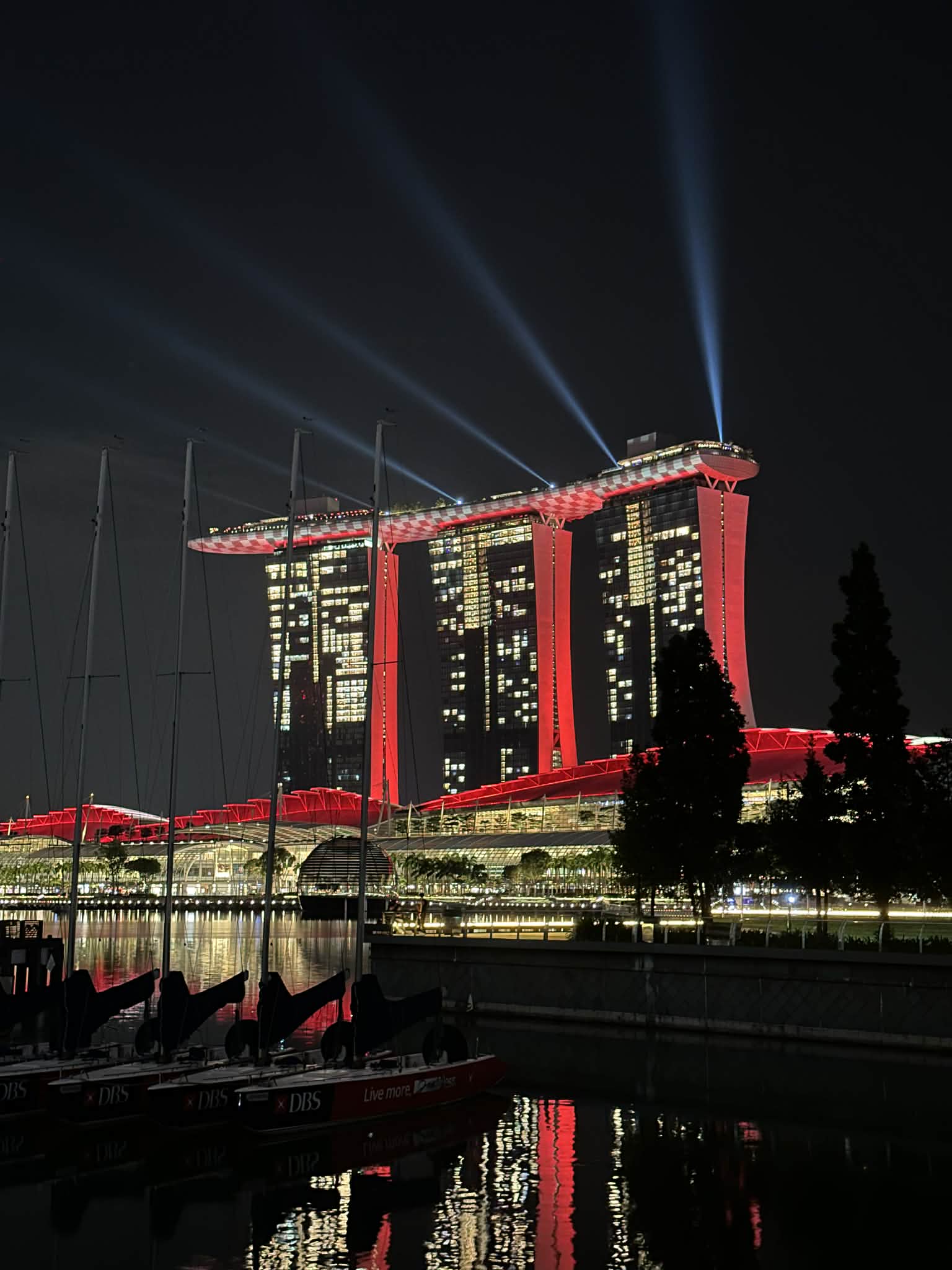
The parade returns to the National Stadium. Tickets to the parade itself are balloted among Singaporeans and permanent residents, but the preview and rehearsal shows on the preceding Saturdays are the traveller's route in, and the fireworks are visible for free from the Marina Bay promenade, the Esplanade and the Helix Bridge.
The whole city dresses in red and white for a fortnight. It is the best month to understand what Singapore thinks of itself.
September: the Singapore Food Festival
The Singapore Food Festival has moved. It used to run in July, and an enormous amount of published advice still says so.
It now runs in September, across Dempsey, Chinatown and island-wide pop-ups, with hawker showcases, chef collaborations and heritage-recipe programmes. If food is the reason you are coming to Singapore, this is your month. Confirm dates on VisitSingapore.
October: the Formula 1 night race
The F1 Singapore Grand Prix has moved to October. For decades it was a September fixture, and a great deal of the internet has not caught up.
The 2026 race runs 9 to 11 October on the Marina Bay Street Circuit, under lights, through the middle of the city.
It is genuinely one of the great sporting spectacles, and it is also the single most expensive week of the Singaporean year. Marina Bay hotels run four-figure nightly rates with minimum-stay requirements, and roads across the bay close for days. Come for it deliberately, or come the week after and enjoy a city that has gone quiet again.
Halloween Horror Nights at Universal Studios on Sentosa runs from late September into early November, and the Deepavali light-up begins transforming Little India through the second half of October.
#Getting Around
Changi Airport (SIN) connects to the city on the East-West MRT line in around 30 minutes to City Hall.
Taxis to downtown run S$25–45 plus the Changi surcharge; Grab and Gojek price similarly.
Fares rose on 27 December 2025. The Public Transport Council's 2025 fare review raised adult card fares by up to 10 cents a journey and cash fares by 20 cents. An adult tapping in with a card now pays from S$1.28 for a short hop up to roughly S$2.57 for a long cross-island ride. Guides quoting a flat "S$1 to S$3" are out of date at the bottom of the range.
Use an EZ-Link card or simply tap a contactless Visa or Mastercard via SimplyGo, which charges the same fares with nothing to buy. Both work on MRT, LRT and buses. The MRT is air-conditioned, fast and immaculate, and it reaches everywhere a visitor needs to go. Eating, drinking and durian are all prohibited on board, and the fines are enforced.
#Budget & Costs
| Travel style | Per day | What it covers |
|---|---|---|
| Budget | S$60–95 | Hostel dorm, hawker meals, MRT everywhere |
| Mid-range | S$120–190 | 3 or 4-star hotel, hawker and casual mix |
| Comfortable | S$250–420 | 4 or 5-star hotel, restaurants, paid sights |
| Luxury | S$700–1,500+ | Marina Bay Sands, Raffles, Fullerton, Capella |
Singapore is consistently one of Asia's more expensive cities, and the dry season contains both the year's best value in March and May and its single most expensive week, the October F1 weekend, when the luxury tier runs to multiples of the figure above.
Hostel dorms are S$25–45/night and three or good four-star hotels S$150–250/night.
Reference costs:
| What | Price |
|---|---|
| Universal Studios Singapore | S$83 |
| Mid-range restaurant | S$40–80 |
| Singapore Sling, Long Bar | S$39 |
| Marina Bay Sands SkyPark | S$32 |
| Gardens by the Bay | S$32 |
| Taxi, Changi to downtown | S$25–45 |
| Casual restaurant | S$15–30 |
| Beer in a bar | S$12–18 |
| Hawker meal | S$5–10 |
| MRT single ride | S$1.28–2.57 |
Where the money actually goes:
- The bill is bigger than the menu says. Restaurants add 10% service and 9% GST on top of the listed price, which lifts every mid-range meal by close to a fifth.
- Hawker centres are the whole budget strategy. At S$5–10 a meal against S$40–80 in a mid-range restaurant, where you eat is the single biggest lever on a Singapore day.
- The MRT makes transport a rounding error. At S$1.28–2.57 a card fare, getting around costs less than one drink.
- One week breaks the pattern completely. The October F1 weekend prices the luxury tier at several times its normal rate.
The dry season is when Singapore's price spread is at its widest, and the good news is that the spread is almost entirely optional. The same city, the same weather and the same MRT serve a S$60 day and a S$1,500 one, and the difference is where you sleep and where you eat rather than what you see. Gardens by the Bay, the SkyPark and Universal cost the same to everyone. Pick March or May, eat at hawker centres, and Singapore stops being an expensive city.
#Food & Dining

Singapore is one of the great food cities on earth, and most of its best food costs under S$10.
Maxwell Food Centre (Chinatown) is the famous one, and Tian Tian Hainanese chicken rice (S$5–7) is the queue worth joining once.
Tiong Bahru Market does the city's best traditional breakfast.
Old Airport Road Food Centre is the quieter local favourite.
Lau Pa Sat in the CBD is touristy, but the satay street that spills onto Boon Tat Street from about 7pm is the real thing.
Newton Food Centre is the open-air evening hawker centre that appeared in Crazy Rich Asians.
Up the scale: Candlenut in Dempsey Hill was the world's first Michelin-starred Peranakan restaurant (S$100–150 a head).
Burnt Ends is the modern-barbecue institution.
Odette at the National Gallery holds three stars and books out months ahead.
For chilli crab, Jumbo Seafood is the tourist standard and No Signboard Seafood in Geylang the local one, at roughly S$60–90 per head.
Two things worth knowing. Hawker centres are open-sided but roofed, so they work in any weather. And in the SW-monsoon months, when a haze episode lands, the hawker centre is one of the few places that feels entirely normal.
#Nightlife
Singapore's bar scene is one of the strongest in Asia and it skews indoors, which is fortunate given the climate.
Atlas in Bencoolen, with its art-deco gin tower, is the most photographed bar in the country.
Manhattan at the Conrad Centennial is a permanent fixture of the World's 50 Best Bars.
Jigger & Pony is a perennial regional number one.
28 HongKong Street is the original speakeasy.
Native on Telok Ayer builds every drink from Southeast Asian ingredients.
For height, CÉ LA VI on the Marina Bay Sands rooftop is the icon.
Note that 1-Altitude at One Raffles Place is closed for redevelopment and still appears on a great many "best rooftop" lists that nobody has updated.
Zouk at Clarke Quay is the anchor club, and Tanjong Beach Club on Sentosa is the daytime-into-evening option.
#Shopping
Orchard Road is the 2.4km spine: ION Orchard, Takashimaya, Paragon, Tangs, Wisma Atria, all connected underground.
Marina Bay Sands holds the luxury mall.
Bugis Street Market is cheap and chaotic.
Haji Lane in Kampong Glam has the independents.
Tiong Bahru has the design shops and bakeries.
Mustafa Centre in Little India is open around the clock and sells literally everything.
One important correction: the Great Singapore Sale, in its old centralised June-to-August form, ended after 2022. There is no longer a single island-wide sale season, and any guide promising one is years stale. Individual malls and brands now run their own promotional calendars.
Tourists can reclaim the 9% GST on purchases above S$100 at Changi.
#Culture & Etiquette
- English is the working language. Speak it freely. What you will hear is Singlish, an English-Malay-Hokkien-Tamil blend, and "lah" on the end of a sentence is the tell.
- Tipping is not the custom. Restaurants add 10% service and 9% GST automatically.
- The fines are real and they are enforced: littering (from S$300), eating or drinking on the MRT (up to S$500), jaywalking, and durian on public transport (prohibited outright).
- Religious sites: cover shoulders and knees at Sultan Mosque, Sri Mariamman, Sri Veeramakaliamman and the Buddha Tooth Relic Temple. Remove shoes at temple entrances. Ask before photographing a ceremony.
- Vaping penalties rose sharply on 1 May 2026 and now reach S$10,000. Devices are routinely detected at Changi customs. Leave it at home.
- Drug laws are among the harshest in the world. Trafficking carries a mandatory death penalty. Never carry anything for anyone.
#Essential Local Phrases
Singapore has four official languages plus Singlish (a localised English-Malay-Hokkien-Tamil blend). You'll get by in plain English everywhere, but a handful of local words will help you read menus, order at hawker stalls, and understand what people are saying.
| What you want to say | What you'll hear in Singapore |
|---|---|
| Yes / OK | Can lah (Singlish) |
| No / Cannot do | Cannot (Singlish) |
| Delicious | Shiok (Singlish) |
| To eat / Let's eat | Makan (Malay, universally used) |
| Iced coffee at a hawker stall | Kopi peng (Hokkien) |
| Very hot (weather) | Damn hot sia (Singlish) |
| Spicy | Pedas (Malay) |
| Bill, please (at a restaurant) | Mai dan (Mandarin) |
| Thank you | Terima kasih (Malay) / Xie xie (Mandarin) |
| Sentence emphasis | Lah (added at the end) |
#Packing List
- Cotton or linen clothing. Synthetic fabric turns clammy within an hour at this humidity.
- A compact umbrella, which doubles as sun shade and is used that way by locals.
- A long-sleeved layer for interiors. Singaporean air conditioning is set to a temperature best described as punitive.
- Closed walking shoes plus sandals.
- High-factor sunscreen. You are one degree off the equator and the UV index routinely hits extreme.
- Insect repellent for outdoor evenings.
- N95 masks if you are travelling between June and October 2026, given the haze outlook.
- A Type G adapter (the same three-pin plug as the UK).
- A refillable water bottle. Tap water is safe and excellent.
#Backup Plans (Rainy Days)
Singapore is the best bad-weather city in tropical Asia, and the same circuit that saves a rainy afternoon also saves a hazy one. The CBD is knitted together by underground walkways and connected malls, and no major attraction is more than a few minutes from cover.
The museum run is the backbone: the National Gallery Singapore (from S$25) holds the world's largest public collection of modern Southeast Asian art, and the ArtScience Museum, the Asian Civilisations Museum, the Peranakan Museum and the National Museum of Singapore are all within a short walk of City Hall MRT.
The Cloud Forest and Flower Dome at Gardens by the Bay are fully enclosed and climate-controlled, which makes them the single best haze-day destination in the city: the Cloud Forest holds 22°C at around 70% humidity, filtered, with a 35-metre indoor waterfall.
The S.E.A. Aquarium and Universal Studios Singapore on Sentosa cover a family day. And hawker centres, roofed and open-sided, work in any weather at all.
#Safety & Health
Singapore is among the safest cities in the world. Violent crime is rare and pickpocketing is uncommon even in the busiest tourist districts. The genuine risks here are environmental and legal, not criminal.
Heat is the leading cause of a ruined day. Heat exhaustion and dehydration are entirely routine among visitors who treat a Singaporean afternoon like a European one. Drink far more water than feels necessary, and use the midday hours indoors.
Haze is the defining 2026 risk. With the SIIA's Red Alert outlook for the second half of the year, check the PSI at haze.gov.sg daily during a June-to-October trip.
Above 100, sensitive groups (children, older travellers, anyone with asthma or a heart condition) should cut back outdoor activity.
Above 200, everyone should, and an N95 mask is worth wearing outside. Surgical and cloth masks do essentially nothing against fine particulates.
Dengue is a year-round concern and the mosquito is a daytime biter. Use repellent, and check the NEA dengue cluster map if staying outside the centre.
Vaping penalties rose to as much as S$10,000 on 1 May 2026, and etomidate-laced pods are now handled under drug law, with possession carrying the possibility of a long custodial sentence and caning. These rules apply to tourists exactly as they apply to residents.
Drug laws are among the harshest anywhere; trafficking carries a mandatory death penalty.
Tap water is safe and excellent. Healthcare is world class and expensive, so travel insurance is strongly recommended.
Emergency numbers: 999 (police), 995 (ambulance and fire).
#What's Changed for 2026/2027 Travellers
- The F1 Singapore Grand Prix has moved to October. The 2026 race runs 9 to 11 October, not in September. A large amount of published advice still has this wrong, and it is an expensive thing to get wrong.
- The Singapore Food Festival has moved to September. It used to be a July event.
- The Great Singapore Sale no longer exists in its centralised June-to-August form; it ended after 2022.
- The SIIA has issued a Red Alert haze outlook for the second half of 2026, on the back of a forecast El Niño and positive Indian Ocean Dipole. Peak risk is August to September.
- Public transport fares rose on 27 December 2025. Adult card fares now run S$1.28 to about S$2.57.
- Vape penalties rose on 1 May 2026 to as much as S$10,000, with Kpods handled under drug law.
- National Day 2026 falls on Sunday 9 August, Singapore's 61st, with the parade back at the National Stadium.
- 1-Altitude is closed for redevelopment, despite its continued presence on rooftop-bar lists.
- The DBS Marina Regatta has not returned since 2019. Dragon boat racing now happens at Bedok Reservoir.
#About This Guide
Research for this guide combined traveller reports from r/singapore and Tripadvisor's Singapore forum with primary and near-primary sources: the Singapore Institute of International Affairs Haze Outlook 2026 for the Red Alert assessment, the El Niño and positive-IOD forecast, and the August-to-September peak-risk window; NEA's haze.gov.sg for the PSI bands and live readings; the Public Transport Council's 2025 fare review for the 27 December 2025 fare adjustment; the Singapore Grand Prix for the 9 to 11 October 2026 race dates; VisitSingapore for the Singapore Food Festival's move to September and for National Day 2026; the official Chingay site for the 27 and 28 February 2026 parade dates; the Health Sciences Authority for the vaping penalties that rose on 1 May 2026; and the Meteorological Service Singapore for the monsoon structure, the Sumatra-squall pattern and the climate normals. Climate figures use MSS/NEA 1991-2020 normals.
You might also like
Destinations picked for travellers with similar taste or climate.
Frequently Asked Questions
Which dry-season month should I actually pick?
February is the best weather bet: it is the driest month of the year at around 113mm across 11 wet days, and the Chinese New Year colour is still up in Chinatown. May is the best combination of culture and value, with Singapore HeritageFest, the Singapore International Festival of Arts and Vesak Day all landing in the month while hotel rates sit below the June-to-August peak. March is the quiet, cheap, event-light option. Avoid the F1 week in October unless the race is the reason you are coming.
Does Singapore really have a dry season?
Not in the temperate sense. It rains every month, humidity never really drops below 75%, and the temperature barely moves all year. What changes is the character of the rain. February is genuinely dry. March to May is the inter-monsoon, which is the hottest and most thundery stretch of the year. June to September is the Southwest Monsoon, statistically drier but prone to Sumatra squalls that sweep in from the west before dawn. October transitions back toward the wet season.
How bad will the haze be in 2026?
Potentially bad, and this is the single most important thing to know about a mid-2026 trip. The Singapore Institute of International Affairs has issued a Red Alert in its Haze Outlook 2026, warning of a high risk of severe transboundary haze in the second half of the year, driven by a forecast El Niño and a positive Indian Ocean Dipole. That is the same combination behind the severe episodes of 1997 and 2015. Peak risk runs August to September. Check the PSI at haze.gov.sg daily: above 100, sensitive groups should scale back outdoor plans; above 200, everyone should. Pack N95 masks and keep an indoor fallback.
Is the Formula 1 night race in September?
Not any more. The F1 Singapore Grand Prix has moved to October, and the 2026 race runs from 9 to 11 October on the Marina Bay Street Circuit. A great deal of published advice still says September and it is an expensive error: race week is the most costly week of the Singaporean year, with Marina Bay hotels at four-figure nightly rates, minimum-stay requirements, and multi-day road closures across the bay. Either come for the race deliberately, or come the following week when the city empties out.
What’s the weather like in Singapore in Dry Season?
Singapore in Dry Season typically sees temperatures of 24–33°C with around 11–15 days of rain across the period. Pack light, breathable layers and strong sun protection — days get genuinely hot.
How much does it cost to visit Singapore in Dry Season?
Budget-conscious travellers can expect daily costs of $60–1,500+, covering accommodation, food, and local transport. Flexible dates can save up to 20% compared with peak-week rates.