At a Glance
Compared to this destination's peak season
Singapore in July — Travel Guide
By Harry Nara · Last updated
Singapore in July offers some of the best conditions of the year, ideal for foodies. Expect temperatures of 25–32°C, around 13 days of rain, and high crowds across the city. Daily budgets typically land around $80–180 for mid-range travellers. Book accommodation two to three months ahead — the most popular rooms sell out fast during peak visiting windows.
Contents15 sections
#Weather in Singapore in July
Singapore in July averages 25–32°C (77–90°F) with around 13 days of rain, and crowds are high.
| Measure | July in Singapore |
|---|---|
| Daytime high | 30–32°C / 86–90°F |
| Overnight low | 25–27°C / 77–81°F |
| Rain | About 150mm across 13 wet days |
| Humidity | 80–90% |
| Storm timing | Afternoon thunderstorms clearing within 60–90 minutes, leaving evenings dry and warm |
| Haze | Sumatran fires often peak July through September, sometimes pushing PSI into the unhealthy band (101–200) |
July sits in the Southwest Monsoon, the year's drier and slightly cooler half.
What that actually means for your trip:
- July feels marginally less oppressive than April and May. Not cool, but a step down from the inter-monsoon peak.
- Mornings are the reliable outdoor window. The storm pattern is consistent enough to plan a whole trip around.
- Haze is the real variable this month. The ASEAN Specialised Meteorological Centre publishes a seasonal outlook each year; a drier-than-normal forecast for the southern ASEAN region (as in 2026) raises the haze risk, so check it before you book.
- Check haze.gov.sg every morning and keep a single N95 mask in your day bag.
Should you come in July? The weather is among the better halves of the Singaporean year, and the storms are short and predictable. The honest caveat is haze: in a year forecast drier than normal, July sits at the front edge of the risk window, so treat the daily PSI check as part of the routine rather than an afterthought.
#What's New for July 2027
A handful of post-2024 changes affect every July visitor.
- Singapore Food Festival has moved to September. It has left its long-running July slot (the 2026 edition ran September 4–24), so July visitors will see no SFF events.
- NDP rehearsals fill July's Saturdays. National Day 2027 falls on Monday August 9, Singapore's 62nd. The 2026 parade was at the National Stadium; the 2027 venue is announced early in the year, and the rehearsals and Preview Shows on the Saturdays before August 9 come with full fireworks. Source: Visit Singapore National Day.
- Mandai's wildlife cluster has fully come together. Bird Paradise (the relocated Jurong Bird Park) opened with 17 hectares and 3,500+ birds.
Mandai Wildlife West is the free-entry food and play zone next door.
Rainforest Wild Adventure is Asia's first adventure-based wildlife park, added 2024–2025. Plan a half-day across the cluster instead of just the Zoo. Source: Mandai Parks.
- Exploria opened March 2026. A new indoor multimedia attraction with five immersive zones from dinosaurs to the Arctic. Genuinely useful as a haze-day or rain-day pivot.
#What to Do in Singapore in July

NDP Rehearsals (Late July Saturdays)
The four-rehearsal sequence leading up to August 9, 2027 — Preview Show 1, Preview Show 2, NE (National Education) Show 1, NE Show 2 — runs on the Saturdays from mid-July through early August at the parade venue (the National Stadium in 2026; the 2027 venue is confirmed early in the year). The fireworks are full-scale at every Preview Show, so pick a viewing spot with a sightline to wherever the parade is.
Tickets to enter the Stadium itself are distributed via electronic ballot on the NDP eppl portal, typically opening late May and often oversubscribed.
No ticket required to watch the fireworks from the Marina Bay Promenade. Arrive at Bayfront MRT by 5pm for a comfortable spot; the fireworks usually run 8:00–8:20pm.
Hawker Culture Without the Festival
With the Singapore Food Festival now in September, July's food story is the year-round hawker base, which is what makes Singapore food culture famous in the first place. Three hawker centres worth the journey:
- Maxwell Food Centre (Tanjong Pagar): Tian Tian Hainanese Chicken Rice queues by 11:30am; the rest of Maxwell is excellent across the board. Lunch crowds peak 12:30–1:30pm.
- Old Airport Road Food Centre (Dakota MRT): the locals' choice, slightly off the tourist track.
The Hokkien mee at Lao Fu Zi, the char kway teow at Dong Ji, and the rojak at Toa Payoh Rojak are all worth the queue.
- Lau Pa Sat / Satay Street (Raffles Place): the Victorian cast-iron market hall serves day-time hawker; from 7pm the surrounding street closes for satay grills running 7pm to midnight. Touristy but the satay smoke at sunset is a genuine experience.
The Mandai Wildlife Cluster (Half-Day Plan)
Mandai now hosts five connected attractions: Singapore Zoo, River Wonders (boat-based safari with manatees and giant pandas), Night Safari (the world's first nocturnal zoo), Bird Paradise (the relocated Jurong Bird Park, with 3,500+ birds across 8 walk-through aviaries), and the new Rainforest Wild Adventure. Multi-park combo tickets via the Mandai Parks site save 25–35% versus single tickets.
July school holidays end mid-month; the second half of July at Mandai is meaningfully quieter than the first.
Mandai Wildlife West outside the entrances is free to enter, with food (Luke's Lobster, Pavilion Banana Leaf, Mr Holmes Bakehouse), water-play zones, and shaded gardens. Useful as a lunch and cool-down break between Zoo and Night Safari.

Gardens by the Bay + Marina Bay Loop
Gardens by the Bay combines free outdoor (Supertree Grove, the daily 7:45pm and 8:45pm Garden Rhapsody light show, no ticket required) with paid indoor (Cloud Forest at perpetual 23°C, Flower Dome at perpetual 18°C — both world-class refuges from July heat). Combo tickets ~S$32.
The Supertree Grove OCBC Skyway walk (S$14) is a great early-evening option as the day cools.
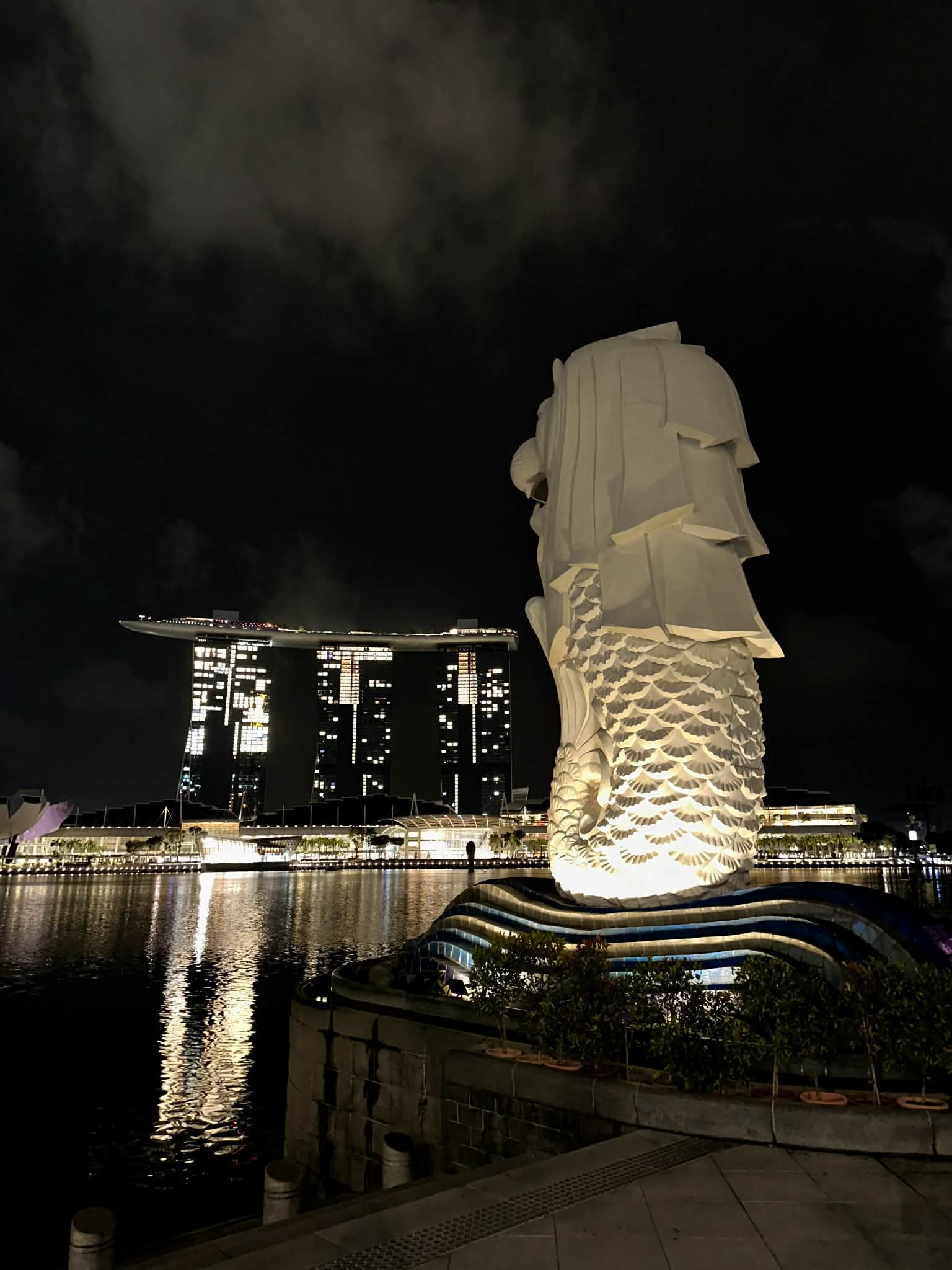
The Marina Bay loop walk runs about 3.5km from the Helix Bridge around to Bayfront MRT, best done after 6pm. You pass the Esplanade theatres, the Merlion statue, the Singapore Flyer, the Marina Bay Sands base, and the Gardens. Free, well-lit, mostly shaded.
Singapore Night Festival Preview (Late July)
The full Singapore Night Festival runs in late August across the Bras Basah / Bugis arts precinct, but several preview installations open in late July around the National Museum, Singapore Art Museum, and Peranakan Museum. Free, walking distance, generally on from 7:30pm. Worth a midweek evening if your dates align.
Sentosa for the School-Holiday Half (Early-to-Mid July)
Universal Studios Singapore, S.E.A. Aquarium, Adventure Cove Waterpark, and Madame Tussauds are all on Sentosa. Singapore school holidays end mid-July, so plan for peak crowds in early July and a meaningful drop after the 15th. Universal Studios single-day adult tickets run S$83; the Adventure Cove + USS combo runs ~S$130.
#Getting Around
Changi Airport (SIN) to City Hall via the East-West MRT runs S$2.50 in 30 minutes.
Grab or taxi to Marina Bay is S$25–45. The MRT and bus network is the only sane way to travel during July's combined heat, humidity, and possible haze. Every train is heavily air-conditioned, and most CBD stations connect directly to nearby buildings via underground sheltered passages.
The EZ-Link / SimplyGo card or any contactless Mastercard/Visa works for tap-and-go fares; no physical card purchase is needed if your bank card supports contactless. Buses and MRT operate 5:30am to midnight; a few NightRider routes run through to 4am on Friday and Saturday.
#Budget & Costs
| Travel style | Per day | What it covers |
|---|---|---|
| Budget | ~S$65–100 | Hostel, hawker meals, museum entries |
| Mid-range | ~S$130–200 | 3 to 4-star hotel, mid-tier restaurants |
| Comfortable | ~S$250–410 | Boutique or luxury 4-star, fine-dining mains |
| Luxury Marina Bay | ~S$620–1,300 | Marina Bay Sands, Fullerton Bay, omakase |
July is shoulder-to-peak season, with hotel rates moderate compared to NDP weekend (Aug 8–9) or the Christmas and New Year peaks.
Hostels run S$30–55/night, three to four-star hotels S$160–280, boutique and luxury four-stars S$300–500, and Marina Bay Sands or the Fullerton Bay S$700–1,400.
Eating runs S$5–10 at a hawker centre, S$25–45 mid-tier, S$60–100 for fine-dining mains and S$300–600 for omakase or a three-star tasting menu, with drinks S$15–25 and rooftop evenings S$80–150.
What the sights cost:
| What | Price |
|---|---|
| Universal Studios, adult | S$83 |
| Bird Paradise, adult | S$48 |
| Singapore Sling, Long Bar | S$45 |
| Bird Paradise, child | S$33 |
| Marina Bay Sands SkyPark | S$32 |
| Cloud Forest + Flower Dome | S$32 |
| Attractions, general | S$30–80 |
| Museum entries | S$15–25 |
| MRT transit, per day | S$3–5 |
Where the money actually goes:
- July sits below the two real peaks. NDP weekend in August and the Christmas to New Year window both cost materially more, which makes July the better-value half of the busy season.
- One drink is worth the tourist tax. The Singapore Sling at the Long Bar is S$45, the only mandatory tourist drink in the city and worth it for the heritage.
- Rooftop evenings rival meals. At S$80–150 an evening they cost more than a mid-tier dinner, so treat them as the night out rather than the prelude.
- Transit stays trivial. S$3–5 a day covers unlimited practical movement around the island.
July is the sensible compromise month in a city with two expensive peaks. It is not the cheapest Singapore, but it avoids both the National Day surge and the festive fortnight while delivering the same attractions at the same prices. The one place to be deliberate is the top of the budget, where the gap between a S$300 boutique four-star and a S$1,400 Marina Bay room buys a view and a pool rather than a better location. Decide whether that view is the trip, because in July it is the largest single line you will pay.
#Where to Stay in Singapore in July
Singapore is small and the MRT is excellent, so where you stay matters less here than in most cities. What it does decide is which of July's two patterns you can walk to. The National Day Parade rehearsals run on late-July Saturdays around Marina Bay, and they are free to watch from the promenade if you are close enough to wander down. The other July factor is haze: fires in Sumatra often peak from July through September, and if the PSI climbs, the value of a hotel shifts towards its pool, its indoor space and how little time you spend outdoors getting to it.
- Splurge: PARKROYAL COLLECTION Marina Bay, Singapore (Marina Bay). Floor-to-ceiling windows with panoramic views over Marina Bay, a mineral water pool and a 24-hour fitness centre, ten minutes' walk from City Hall MRT. On rehearsal Saturdays this puts the bay outside your window rather than at the end of a crowded train ride.
- Sweet spot: PARKROYAL COLLECTION Pickering, Singapore (Chinatown). The hotel-in-a-garden, recognised with a MICHELIN Key in 2025, sitting between Clarke Quay and Chinatown with 450 metres to Telok Ayer MRT. If July delivers a hazy week, a property built around planting and a sun terrace is a better place to be stuck than a glass tower.
- Budget: Amara Singapore (Tanjong Pagar). Four hundred metres from Tanjong Pagar MRT with a Balinese-style pool and a spa, and Chinatown five minutes away. This is the practical July base: air-conditioned, connected, and close to the hawker centres that are the actual reason most people come.
July sits in the drier half of Singapore's year with rain around 150mm across 13 wet days, mostly as short afternoon storms rather than all-day weather. Rates are moderate, with the early-to-mid month busier because of regional school holidays. Check the PSI reading before you commit to an outdoor-heavy day. Each link opens Booking.com with July dates already filled in and that property at the top of the results. Nothing is locked in from there: change the dates, switch neighbourhood, or search an entirely different destination in the same visit.
For the other neighbourhoods, and every hotel we have verified across Singapore, see our full guide to where to stay in Singapore.
Hotel links are affiliate links. We may earn a small commission if you book, at no extra cost to you.
#Food & Dining

Singapore's food scene runs deep beyond the hawker base.
Burnt Ends (Australian wood-fire BBQ, two Michelin stars), Odette (modern French, three stars), Candlenut (the world's only Michelin-starred Peranakan restaurant), and Les Amis (classic French, three stars) anchor the fine-dining tier. Booking: 4–8 weeks ahead for weekends, 2 weeks for weekdays.
Mid-tier favourites that consistently exceed their price point: PS.Cafe (multiple locations, modern Australian-Asian), The Coconut Club (nasi lemak elevated to ~S$25 mains), Wild Rocket (modern Singaporean), Long Beach (chilli crab landmark since 1946), and 328 Katong Laksa (the cult laksa spot featured on Anthony Bourdain).
Year-round hawker essentials beyond the centres above: chicken rice at any branch of Tian Tian or Boon Tong Kee, bak kut teh at Founder in Balestier (the Lee Kuan Yew favourite), and the roti prata breakfast at any 24-hour Indian Muslim restaurant in Geylang.
#Nightlife
Zouk runs full DJ lineups Friday and Saturday.
CÉ LA VI at Marina Bay Sands, LAVO, Smoke & Mirrors at the National Gallery rooftop, and Mr Stork at Andaz Singapore are the rooftop scene with views.
Note that 1-Altitude at One Raffles Place is closed for redevelopment, despite its persistence on rooftop-bar lists.
For cocktail bars, Singapore consistently ranks in the world's top 5 bar cities.
Atlas (Art Deco grandeur in the Parkview Square building), 28 HongKong Street (the speakeasy that started Singapore's craft cocktail scene in 2010), Native (Asia-foraged ingredients), Manhattan Bar at the Regent (consistently top-10 in Asia's 50 Best Bars), Jigger & Pony, and Operation Dagger all reward the booking.
Clarke Quay, Boat Quay, and Holland Village stay buzzy on Friday and Saturday weekly.
Tanjong Pagar has the Korean BBQ and soju-bar concentration.
#Shopping
There is no longer a Great Singapore Sale to plan around: the centralised GSS, which used to run from late June into August, ended after 2022 and no longer exists. Malls now run their own promotional calendars independently, so discounting is patchy rather than island-wide, and the deepest reductions of the year now land at Black Friday in November and in the post-Christmas clearance.
The mid-range and luxury anchors remain ION Orchard, Paragon, Ngee Ann City, Mandarin Gallery, VivoCity and Suntec City.
The Tourist GST refund is available at Changi Airport for foreign-passport purchases over S$100 made at participating retailers.
For independent shopping: Haji Lane in Kampong Glam runs indie boutiques, vintage, and tattoo studios.
Tiong Bahru has a small cluster of design stores and the original Tiong Bahru Bakery.
Dempsey Hill combines colonial-era army barracks with high-end gallery shops, antiques, and rug specialists.
Bugis Street Market is the cheap-and-cheerful end: kitsch souvenirs, T-shirts, cheap bags, cheap sunglasses. Honest about what it is.
#Culture & Etiquette
- Chewing gum is import-controlled. Don't bring it through customs. Doctor-prescribed nicotine gum is exempted.
- Eating or drinking on the MRT carries a S$500 fine. Including water bottles. The fine is enforced.
- Durian on the MRT and buses is banned. Many hotels also prohibit durian in rooms. The smell carries.
- Tipping is not expected. A 10% service charge is built into restaurant bills along with 9% GST. Adding more is fine but not expected.
- Hawker centre etiquette: chope a table with a tissue packet before ordering, return your tray after eating (S$300 fine for not returning since 2021), and don't bargain at hawker stalls. Prices are fixed.
- Modest dress at temples and mosques. Shoulders covered, knees covered for women in many Hindu and Sikh temples; head scarf often provided at mosque entries.
#Essential Local Phrases
Singapore has four official languages plus Singlish (a localised English-Malay-Hokkien-Tamil blend). You'll get by in plain English everywhere, but a handful of local words help you read menus and order at hawker stalls.
| What you want to say | What you'll hear in Singapore |
|---|---|
| Yes / OK | Can lah |
| No / Cannot | Cannot |
| Delicious | Shiok |
| To eat / Let's eat | Makan (Malay, universal) |
| Iced coffee at a hawker stall | Kopi peng (Hokkien) |
| Hot tea | Teh-O (Hokkien) |
| Spicy | Pedas (Malay) |
| Bill, please | Mai dan (Mandarin) |
| Thank you | Terima kasih (Malay) / Xie xie (Mandarin) |
| Sentence emphasis | Lah (added to end of any sentence) |
#Packing List
- Light cotton or linen, fabrics that breathe in 80–90% humidity
- Compact umbrella for the inevitable afternoon thunderstorm
- N95 mask in case of haze
- Sunglasses and high-SPF sunscreen
- Reusable water bottle (Singapore tap is excellent and free at fountains)
- Smart-casual outfit for rooftop bars (most decline shorts in the evening)
- Light jumper for aggressive mall and MRT air-conditioning
- Comfortable walking shoes for hawker-centre crawls and underground walkways
- Cash for hawker stalls (most accept QR PayLah! / PayNow but cash is universal backup)
#Backup Plans
If haze rises (PSI 100+): Singapore is the world-class champion of indoor refuges.
Marina Bay Sands Shoppes, Jewel Changi (the indoor rainforest), ION Orchard, VivoCity, and Suntec City are sprawling air-conditioned complexes with cinemas, restaurants, and hours of shopping.
Cloud Forest at Gardens by the Bay sits at perpetual 23°C with cleansed air.
National Gallery Singapore, ArtScience Museum at Marina Bay Sands, and the Asian Civilisations Museum are all excellent indoor full-day options.
If a thunderstorm catches you outdoors: the underground sheltered network from Esplanade through City Hall to Raffles Place runs about 1.5km without going outside. Most CBD office buildings allow public access to their ground-floor cafés.
If you wanted Singapore Food Festival and your dates can't shift to September: prioritise the year-round hawker centres listed above, plus a half-day Peranakan deep-dive at Joo Chiat (Katong Laksa, Peranakan houses, a heritage-food walking tour). The hawker base is what SFF showcases anyway, and it's available all year.
#Safety & Health
July's main risks: heatstroke, dengue, and haze.
- Heat: Singapore's combination of 32°C and 85% humidity is medically taxing. Drink water continuously, take a 15-minute air-conditioned break every 90 minutes outside, and avoid sustained outdoor walking between 11am and 3pm.
- Haze: Check haze.gov.sg every morning. PSI 0–50 is good, 51–100 moderate, 101–200 unhealthy, 201–300 very unhealthy. N95 masks are sold at any 7-Eleven for ~S$2 each. People with respiratory conditions should monitor PSI closely.
- Dengue: Singapore has periodic dengue outbreaks. The National Environment Agency runs the dengue cluster map; avoid known cluster neighbourhoods if possible and use mosquito repellent at dusk.
- Lightning during afternoon thunderstorms is genuinely common. Take shelter indoors or under solid cover; open beach areas and exposed bridges are the highest-risk locations.
- Tap water is excellent and safe everywhere. Singapore is a global benchmark for urban water quality.
- Drug laws are extreme. Trafficking carries the death penalty. Personal-use possession can result in long sentences. Do not bring any controlled substance.
Healthcare is world-class but expensive; travel insurance is recommended.
Emergency numbers: 999 (police), 995 (ambulance/fire). The Singapore Tourism Board operates a 24/7 helpline (1800-736-2000) for visitor emergencies.
#About This Guide
Research for this guide combined first-hand traveller reports from r/singapore and Tripadvisor's Singapore forum threads with primary sources: Visit Singapore for the Singapore Food Festival's move to September, Visit Singapore for National Day details, the NEA Haze Information Portal for current PSI readings and the monsoon forecast, the ASEAN Specialised Meteorological Centre for southern ASEAN rainfall projections, Mandai Parks for the Bird Paradise + Mandai Wildlife West + Rainforest Wild Adventure cluster, and NEA dengue cluster maps for current outbreak zones. Climate figures use Meteorological Service Singapore / NEA 1991-2020 normals.
This guide is reviewed twice yearly, ahead of each Southwest Monsoon.
Last reviewed: September 2026. Next scheduled review: January 2027. If you spot something out of date, email contact@when-to-wander.com and we'll correct it.
You might also like
Destinations picked for travellers with similar taste or climate.
Frequently Asked Questions
Is July a good time to visit Singapore?
Yes, if you plan around the heat and the haze risk. July brings the National Day Parade rehearsals and Preview Shows on its Saturdays, the Mandai wildlife cluster (Bird Paradise, the Zoo, Night Safari, Rainforest Wild Adventure) makes a strong half-day, and Singapore's hawker centres are as good as ever. Weather is warm (27–32°C) with about 13 wet days, mostly afternoon thunderstorms after sunny mornings. School is back in session (the June holidays end in late June), so attractions are calmer on weekdays than in June. The Singapore Food Festival is no longer a July event; it has moved to September.
Is the Singapore Food Festival in July?
Not any more. The Singapore Food Festival (SFF) left its long-running July slot and now runs in September (September 4–24 in 2026) at Dempsey, Chinatown and island-wide pop-ups. July remains a strong food month on Singapore's year-round hawker base: chicken rice at Maxwell, chilli crab at Jumbo, laksa at 328 Katong, and the Tekka Centre for biryani and dosa.
Is the Singapore haze bad in July?
Variable — mid-July sees the strongest SW monsoon winds from Sumatra and is the peak of haze risk. Most years the haze is moderate (PSI 50–100), occasionally bad. In the worst years air quality has been hazardous; check haze.gov.sg readings before outdoor planning. N95 masks are sold at all 7-Elevens during haze events.
What's there to do indoors in July?
Plenty — Marina Bay Sands ArtScience Museum, National Gallery Singapore (the largest modern Southeast Asian art collection in the world), the National Museum, the Asian Civilisations Museum, Peranakan Museum, and Singapore Discovery Centre all welcome rainy- or hazy-day visitors. Most cost S$15–25 with combo tickets available.
What’s the weather like in Singapore in July?
Singapore in July typically sees temperatures of 25–32°C with around 13 days of rain across the period. Pack light, breathable layers and strong sun protection — days get genuinely hot.
How much does it cost to visit Singapore in July?
Budget-conscious travellers can expect daily costs of $80–180, covering accommodation, food, and local transport. Prices climb during peak weeks — book early to lock in the lower end of this range.